Led Zeppelin: 50 anos de The Song Remains the Same, entre o palco e a fantasia
Em 1976, enquanto o punk começava a desafiar os excessos do rock, o Led Zeppelin chegava aos cinemas com um espetáculo monumental, filmado três anos antes no Madison Square Garden.
Em 1976, o mundo parecia ter pressa. O Concorde começava a transportar passageiros acima da velocidade do som, Steve Jobs e Steve Wozniak davam os primeiros passos da Apple e quatro rapazes de jaquetas de couro, conhecidos como Ramones, lançavam em Nova York um disco que não precisava de meia hora para dizer a que veio.
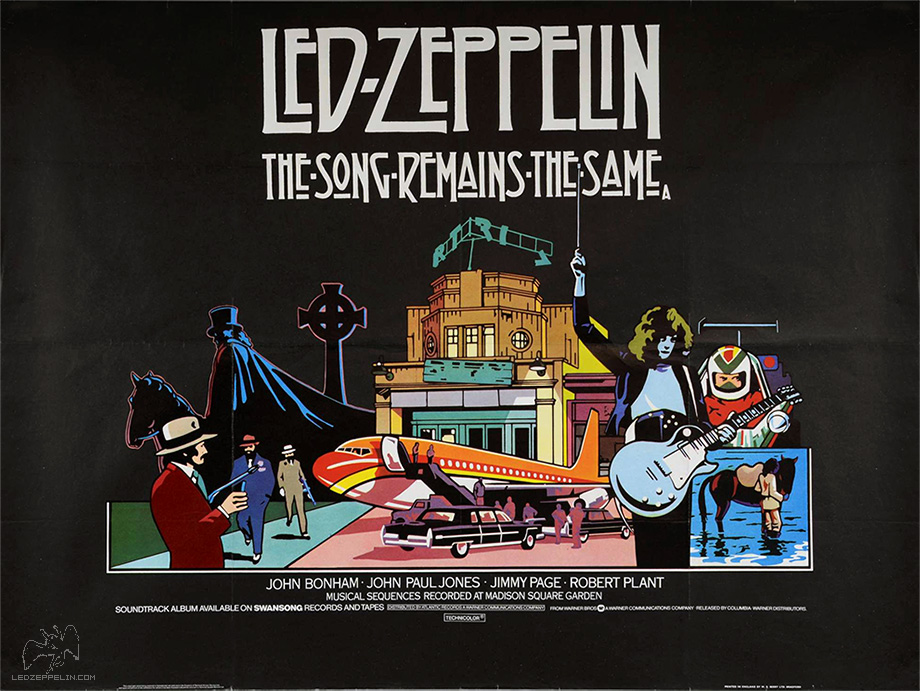
O rock também estava mudando. De um lado, o punk anunciava uma nova maneira de fazer música: mais curta, direta e sem cerimônia. Do outro, o Led Zeppelin preparava sua chegada às telas de cinema com guitarras monumentais, solos intermináveis e uma boa dose de fantasia.
Em 20 de outubro daquele ano, The Song Remains the Same estreava comercialmente em Nova York, levando ao cinema três noites de apresentações realizadas no Madison Square Garden, em julho de 1973.
Era uma viagem ao passado recente de uma banda que já havia transformado o espetáculo de rock em algo muito maior do que quatro músicos tocando sobre um palco.
E o filme estava longe de ser apenas um registro de concerto.
Três noites em Nova York e quatro câmeras
Em julho de 1973, o Led Zeppelin encerrava uma bem-sucedida turnê norte-americana. Jimmy Page, Robert Plant, John Paul Jones e John Bonham estavam entre os músicos mais celebrados do planeta. O álbum Houses of the Holy havia sido lançado poucos meses antes, e os concertos reuniam multidões.
As apresentações de 27, 28 e 29 de julho, no Madison Square Garden, foram escolhidas para registrar a banda em ação. A operação, porém, estava longe de ser simples.
O diretor Joe Massot já havia apresentado anteriormente a proposta de realizar um filme sobre o grupo. A negociação avançou com Peter Grant, empresário conhecido por sua atuação rigorosa nos negócios do Led Zeppelin.
Os preparativos aconteceram rapidamente. A equipe começou a produzir imagens complementares durante a passagem por Pittsburgh e chegou a Nova York com a missão de registrar uma apresentação marcada por improvisações, mudanças de iluminação e músicos que não tinham a menor obrigação de permanecer imóveis diante das câmeras.
Para as filmagens, foram utilizadas até quatro câmeras de 35 mm, além de equipamentos de 16 mm destinados a imagens dos bastidores e do público.
Era uma estrutura limitada para documentar a dimensão do espetáculo. E, quando as filmagens terminaram, descobriu-se que algumas sequências importantes não haviam sido registradas de maneira satisfatória.
A solução seria tão trabalhosa quanto inusitada.
O Madison Square Garden reconstruído na Inglaterra
Com o projeto enfrentando dificuldades, Joe Massot acabou afastado da direção, e o australiano Peter Clifton assumiu a responsabilidade de concluir o filme.
Parte das imagens originais não era suficiente para construir as sequências planejadas. Em agosto de 1974, mais de um ano depois dos concertos, os músicos retornaram aos figurinos e instrumentos diante das câmeras.
Desta vez, porém, não estavam em Nova York.
As novas cenas foram realizadas nos Shepperton Studios, na Inglaterra, onde foi reconstruído um cenário inspirado no palco do Madison Square Garden.
A intenção era complementar as apresentações filmadas em 1973, preenchendo lacunas visuais e permitindo uma montagem mais consistente.
Isso significa que algumas imagens vistas no longa foram produzidas longe da plateia nova-iorquina, embora integradas ao áudio e aos registros dos concertos originais.
O resultado tornou-se uma curiosidade permanente para os admiradores da banda, que passaram a observar detalhes de figurinos, instrumentos, iluminação e aparência dos músicos na tentativa de identificar as cenas refeitas.
Quando o rock encontra a fantasia
Se as apresentações já ofereciam material suficiente para um filme de concerto, o Led Zeppelin decidiu seguir por um caminho menos convencional.
The Song Remains the Same também mergulhou no imaginário particular de seus integrantes, apresentando sequências de fantasia que interrompiam as performances para explorar personagens, interesses e referências pessoais.
Jimmy Page aparece envolvido em uma atmosfera mística, interpretando uma figura associada ao universo do eremita, símbolo também presente nas cartas de tarô.
Robert Plant assume a identidade de um herói medieval, em uma aventura com cavaleiros, castelos e imagens inspiradas nas histórias de fantasia.
John Paul Jones surge em uma narrativa que combina a tranquilidade da vida familiar com elementos de um universo fantástico.
John Bonham, por sua vez, é apresentado longe dos palcos, entre cenas de sua vida cotidiana, motocicletas, carros e sua ligação com o ambiente rural.
Até Peter Grant, o empresário da banda, participa das sequências dramatizadas, reforçando o caráter peculiar de uma produção que mistura espetáculo musical e encenação.
O filme não pretendia apenas mostrar como o Led Zeppelin tocava. Queria oferecer ao público uma visita ao universo daqueles quatro músicos.
E não havia exatamente modéstia nessa proposta.
Do arco de violino de Jimmy Page ao solo de John Bonham
Apesar das fantasias e dos bastidores, é no palco que The Song Remains the Same encontra sua principal força.
O repertório reúne algumas das composições mais importantes do grupo, entre elas Rock and Roll, Black Dog, Since I’ve Been Loving You, No Quarter, Stairway to Heaven, Moby Dick, Dazed and Confused e Whole Lotta Love.
Em Dazed and Confused, Jimmy Page explora improvisações e utiliza um arco de violino sobre as cordas de sua guitarra, produzindo efeitos sonoros que se tornaram uma de suas marcas nos concertos.
A interpretação se estende muito além da duração da gravação original de estúdio, revelando o espaço que a banda reservava à experimentação.
Em Moby Dick, John Bonham assume o protagonismo com um extenso solo de bateria, incluindo passagens executadas com as próprias mãos.
Robert Plant alterna potência vocal e improvisação, enquanto John Paul Jones sustenta a estrutura musical com a discrição de quem não precisava disputar os holofotes para demonstrar sua importância.
É justamente essa liberdade que ajuda a explicar o contraste com os novos movimentos musicais de 1976.
Enquanto os Ramones condensavam 14 músicas em menos de meia hora no álbum de estreia, o Led Zeppelin podia dedicar uma parcela considerável de seu espetáculo a uma única composição.
Duas maneiras radicalmente diferentes de entender o rock dividiam o mesmo período histórico.
Mick Jagger na plateia e uma festa no Hotel Pierre
Depois de três anos de produção, The Song Remains the Same finalmente ficou pronto.
A pré-estreia mundial aconteceu em 19 de outubro de 1976, no Cinema One, em Nova York. Jimmy Page, Robert Plant, John Paul Jones e John Bonham compareceram ao evento, que também recebeu convidados como Mick Jagger, Carly Simon e Roberta Flack.
A comemoração continuou no Hotel Pierre, onde uma festa beneficente arrecadou US$ 25 mil para a organização Save the Children.
No dia seguinte, 20 de outubro, o filme iniciou sua exibição comercial em Nova York. Outras cidades norte-americanas e Toronto receberam o longa ainda naquela semana.
A trilha sonora já havia chegado às lojas em 28 de setembro de 1976, em um álbum duplo lançado pela Swan Song Records, gravadora criada pelo próprio Led Zeppelin.
Para uma banda que havia construído sua reputação principalmente nos palcos e nos discos, o cinema oferecia uma nova maneira de alcançar o público.
Led Zeppelin na televisão? Quase um acontecimento
Outra curiosidade envolve a divulgação do filme na televisão americana.
Em 15 de outubro de 1976, a Swan Song anunciou que trechos de The Song Remains the Same seriam exibidos no programa musical Don Kirshner’s Rock Concert.
O material incluía uma apresentação de Black Dog e parte de Dazed and Confused, acompanhada da sequência de fantasia de Jimmy Page.
O comunicado da gravadora apresentava a transmissão como a primeira performance do Led Zeppelin exibida na televisão.
Para um grupo que privilegiava as grandes apresentações ao vivo e mantinha uma relação relativamente reservada com a exposição televisiva, a iniciativa fazia parte de uma estratégia incomum de divulgação.
O cinema havia levado o Led Zeppelin às telas. Agora, fragmentos daquela experiência também chegariam às salas de estar americanas.
Cinquenta anos depois
The Song Remains the Same recebeu novas edições ao longo das décadas, incluindo uma versão remasterizada para vídeo em 2008, acompanhada de apresentações adicionais e materiais de arquivo.
Em 2018, Jimmy Page supervisionou uma nova remasterização da trilha sonora, disponibilizada em diferentes formatos, entre eles uma edição especial com CDs, LPs, DVDs e reproduções de materiais históricos.
O longa conserva também as imperfeições de sua produção: diferenças de continuidade, encenações extravagantes e escolhas cinematográficas que refletem o gosto e as possibilidades técnicas dos anos 1970.
Mas talvez seja justamente isso que o torne tão particular.
Em uma época em que o punk começava a reduzir o rock ao essencial, o Led Zeppelin apresentava ao público uma produção cinematográfica que parecia não conhecer limites de duração ou imaginação.
Cinquenta anos depois da estreia, The Song Remains the Same continua oferecendo algo que nenhuma reconstrução de estúdio poderia fabricar por completo: o encontro de Jimmy Page, Robert Plant, John Paul Jones e John Bonham diante de uma plateia, em três noites de julho de 1973.
O resto é cinema.
Rocksy
Fontes: Led Zeppelin — acervo e discografia oficiais; Swan Song Records — comunicados de 1976; Rhino Entertainment; Smithsonian National Air and Space Museum; Apple Newsroom.
🇺🇸 English Version ↓
Led Zeppelin: 50 Years of The Song Remains the Same
As punk rock began challenging the excesses of the 1970s, Led Zeppelin took its larger-than-life stage show to movie theaters. Fifty years later, the story behind the film is nearly as fascinating as the performances themselves.
1976 was a year of big changes. Concorde had begun flying passengers at supersonic speeds, Steve Jobs and Steve Wozniak were getting Apple off the ground, and four guys in leather jackets from Queens had just released an album that packed 14 songs into less than 30 minutes.
Those guys were the Ramones. And they weren’t particularly interested in guitar solos.
Rock was heading in two very different directions. Punk was stripping things down to three chords, short songs and raw energy. Meanwhile, Led Zeppelin was doing just the opposite, bringing its thunderous sound, extended improvisations and elaborate fantasies to the silver screen.
On October 20, 1976, The Song Remains the Same opened in New York City, offering moviegoers a front-row seat to three concerts filmed at Madison Square Garden in July 1973.
It was already a glimpse into another moment in rock history. And getting it onto the screen had been quite an adventure.
Three Nights at Madison Square Garden. Four Cameras. Plenty of Trouble.
By the summer of 1973, Led Zeppelin was operating on an extraordinary scale.
Jimmy Page, Robert Plant, John Paul Jones and John Bonham were nearing the end of a hugely successful North American tour. Houses of the Holy had arrived that March, and the band’s concerts were major events.
Their three-night stand at Madison Square Garden, July 27–29, seemed like the perfect opportunity to capture Led Zeppelin in full flight.
Director Joe Massot had approached the band about making a concert film, and manager Peter Grant eventually gave the project the green light.
There was just one problem: filming Led Zeppelin wasn’t quite as straightforward as pointing a camera at the stage.
The band rarely played a song exactly the same way twice. Improvisations could stretch well beyond the original recordings, the stage lighting constantly shifted, and the musicians moved wherever the music took them.
The crew worked with up to four 35mm cameras, occasionally supplemented by 16mm equipment for crowd shots and backstage footage.
For a band capable of turning a single song into a twenty-minute excursion, that wasn’t much coverage.
When the footage was reviewed, it became clear that some crucial shots were missing. Others simply didn’t provide enough material to build the concert sequences the filmmakers wanted.
The movie had a problem. And the solution would take everyone back onto a stage — just not the one in New York.
Madison Square Garden, Made in England
As the production dragged on, Massot was replaced by Australian filmmaker Peter Clifton, who took over the difficult task of bringing the project together.
In August 1974, more than a year after the Madison Square Garden concerts, Led Zeppelin returned to work in front of the cameras.
This time, they were at Shepperton Studios in England.
A replica of the New York stage had been constructed, allowing the musicians to recreate portions of their performances for the missing camera angles.
The additional footage was then blended with the original concert material.
For years, eagle-eyed fans have enjoyed spotting the differences between the genuine Madison Square Garden footage and the scenes shot later in England.
Changes in hairstyles, costumes, lighting and camera angles offer clues to what happened where.
Not exactly the kind of detective work most concert movies require.
But The Song Remains the Same was never going to be an ordinary concert movie.
Four Musicians, Four Very Different Fantasies
Between performances, the film ventures into a series of elaborate fantasy sequences, each offering a glimpse into the interests and imagination of a Led Zeppelin member.
Jimmy Page enters a mystical world inspired by the Hermit, a figure associated with tarot symbolism. It’s an appropriately mysterious setting for a guitarist whose fascination with the occult had become part of his public image.
Robert Plant takes a different route, becoming a sword-wielding medieval hero in a landscape of castles, knights and fantasy adventure.
John Paul Jones appears in scenes that move between domestic life and a more dreamlike world.
John Bonham’s contribution is considerably more down-to-earth. His scenes feature motorcycles, automobiles, the countryside and moments away from the demands of touring.
Even Peter Grant makes an appearance in dramatized sequences, adding another layer to an already unconventional production.
Some of it is theatrical. Some of it is wonderfully strange. And much of it could only have come from the rock culture of the 1970s.
Rather than settle for a straightforward account of life on the road, Led Zeppelin turned the movie into an extension of its own mythology.
Subtlety was clearly not the assignment.
A Violin Bow, a Drum Solo and No Reason to Watch the Clock
For all the cinematic detours, the music remains the main attraction.
The film includes Rock and Roll, Black Dog, Since I’ve Been Loving You, No Quarter, Stairway to Heaven, Moby Dick, Dazed and Confused and Whole Lotta Love, among other performances.
During Dazed and Confused, Page stretches the song into an extended improvisation, drawing eerie sounds from his guitar with a violin bow.
Bonham gets his own showcase in Moby Dick, delivering a marathon drum solo that includes passages played with his bare hands.
Plant moves between powerful vocals and spontaneous exchanges with the band, while Jones provides the musical foundation that allows everyone else to wander without losing their way.
The performances capture something that studio albums, however brilliant, could only suggest: Led Zeppelin’s ability to reshape its music in real time.
And that brings us back to 1976.
The Ramones had released a debut album containing 14 tracks in under half an hour. Led Zeppelin could spend almost that much time on one number.
Neither approach needed the other’s approval.
One was helping redefine rock’s future. The other was bringing the spectacular scale of early-1970s arena rock to movie audiences.
And both belonged to the same remarkable musical moment.
Mick Jagger, the Pierre Hotel and a Long-Awaited Premiere
After three years of filming, editing, additional shooting and soundtrack work, The Song Remains the Same was finally ready for audiences.
The world premiere took place on October 19, 1976, at Cinema One in New York.
All four members of Led Zeppelin attended, along with a guest list that included Mick Jagger, Carly Simon and Roberta Flack.
The celebrations continued at the Pierre Hotel, where a benefit event raised $25,000 for Save the Children.
The movie began its regular New York theatrical run the following day, October 20, with openings in other North American cities later that week.
Its companion double live album had been released through Swan Song Records, Led Zeppelin’s own label, giving fans another way to experience the Madison Square Garden performances.
For a band that had established its reputation through albums and concerts rather than frequent television appearances, the movie represented a different kind of introduction.
People who had never managed to get a concert ticket could finally experience a little of what all the excitement was about.
Even if they had to sit through a few medieval adventures along the way.
Led Zeppelin on American Television? Now That Was News.
The film also prompted an unusual promotional move.
On October 15, 1976, Swan Song announced that footage from The Song Remains the Same would air on the nationally syndicated television program Don Kirshner’s Rock Concert.
The scheduled segment included Black Dog and an excerpt from Dazed and Confused, complete with Page’s fantasy sequence.
The label promoted it as Led Zeppelin’s first televised performance.
The announcement was significant for a band that had long favored the concert stage over the television studio.
With a major motion picture to promote, however, American television offered a chance to reach audiences far beyond the concert circuit.
The band had conquered arenas. Now it was making an appearance in America’s living rooms.
Fifty Years On, the Music Is Still the Main Event
The Song Remains the Same has been revisited several times since 1976.
A remastered home-video edition arrived in 2008, bringing restored material, additional performances and archival footage to a new generation of viewers.
In 2018, Jimmy Page oversaw another remaster of the soundtrack, released in multiple formats, including an elaborate collector’s edition.
The film still carries the unmistakable fingerprints of its era: fantasy sequences, continuity quirks, ambitious staging and occasional moments when rock-star imagination gets a little carried away.
But the imperfections are part of its character.
What makes the film worth revisiting isn’t simply the spectacle or the mythology. It’s the chance to watch Page, Plant, Jones and Bonham playing together, responding to one another and pushing familiar songs somewhere unexpected.
In 1976, punk was beginning to challenge the notion that rock needed to be bigger, longer and more elaborate.
Led Zeppelin, meanwhile, was arriving at the movies with a film that embraced all three.
Fifty years later, those three nights at Madison Square Garden remain the heart of The Song Remains the Same.
Everything else?
That’s cinema.
Rocksy
Sources: Led Zeppelin Official Website and Discography; Swan Song Records (1976 press releases); Rhino Entertainment; Turner Classic Movies; Apple Newsroom; Smithsonian National Air and Space Museum.